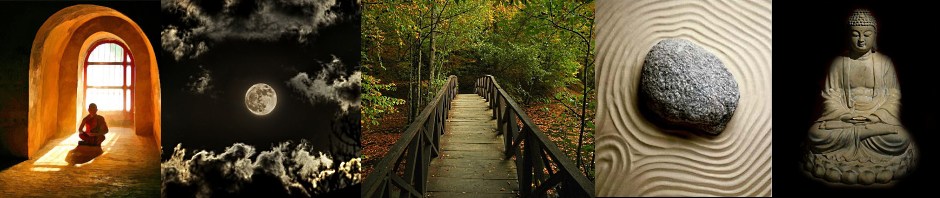
Transformation

This transformation expresses the boundless compassion, nonjudgmental and all-inclusive, that is the moving force in the Buddhist tradition. It is not, however, a simple, naive optimism, for the starting point of Buddhism is a recognition of the universal fact of human suffering, born of both personal and collective karma. In fact, it is a realistic appraisal of life as it is, not merely on the surface of things but at its most profound depth. In this depth, abundant with the accumulated pain and sorrow of humanity, is also found the capacity of the human spirit to achieve its fullest potential, no matter the obstacles, through awakening to the working of boundless compassion deep within our life.


From

Shin Buddhism
From “Shin Buddhism: Bits of Rubble Turn into Gold” by Taitetsu Unno

You are….

You are an aperture through which the universe is looking at and exploring itself.

.lotus

                                                                                                                                                                         Alan Watts

The Four Noble Truths

When the Buddha rose from the Bodhi tree he arose awakened.  He discovered the Four Noble Truths of existence, which are:
1. The Truth of Suffering 
The Buddha declared that this world if full of suffering;        that actual existence including birth, decrepitude,        sickness and death is suffering and sorrow. This is called the Truth of Suffering.

2. The Truth of the Cause of Suffering.
The cause of human suffering lies in ignorance and Karma. Ignorance and its resulting Karma have often times been  called “desire” or craving. The Buddha declared:

Verily it is this thirst or craving, causing the renewal of existence, accompanied by sensual delight, seeking  satisfaction now here, now there – the craving for gratification of the passions, for continual existence in the worlds of sense.
3. The Truth of the Cessation of Suffering.  
The extinguishing of all human ignorance and Karma results in a state known as Nirvana. This is the Truth of the        Cessation of Suffering.

4. The Truth of the Path to the Cessation of  Suffering 
The Truth of the Path to the Cessation of Suffering is the Noble Eight-fold Path.

Some have said that Buddhism is rather negative since the FIrst Noble Truth is that Life is Suffering.  I would whole heartedly disagree.  During our next Dharma gathering we will discuss as a group we will discuss our engement with this truths and how they inform our daily practice.

Life comes to us as a great, eternal calling….

lotus

Life comes to us as a great, eternal calling, reaching out to us, unfolding around and inside of us, while at the same time holding us, in our entirety,from the unnamable past to the unknowable future. Life’s eternal truth is our truth, just as surely as our temporal clinging and attachment to the dance of self and ego is our truth. The Buddha’s teaching emanates from deep insight into the unending mix of pain and promise that is human life. Buddha sees what we cannot see, sees that we cannot see, and out of unfathomable concern for our well being, calls out to all humankind with the equally unfathomable message of our liberation from self-imposed restrictions, anxieties and turmoil. The Nembutsu tradition, more broadly known as Pure Land Buddhism, understands the whole of the Buddhist teaching and its history as Buddha’s entreaty, Buddha’s call to us to awaken to this eternal promise, a call carried by the compassionate movement that is life itself.

– Jerry Bolick

The Path of Foolish Beings

headerfbwp

Here is a great article in the magazine Buddhadahrma about the Shin Buddhist path.   Who are the foolish beings? According to the Shin tradition of Pure Land Buddhism, we all are. Mark Unno explains that only by becoming aware of our limited self and acknowledging our fundamental foolishness can we realize the oneness of all beings and the limitless flow of compassion.

One of the implications of the Mahayana Buddhist idea of emptiness is that the important question is not “What does it mean to be a  buddhist?” It is “What does it means to be a human being?” That’s because emptiness applies to Buddhism itself as much as it does to ordinary objects of attachment. It is only when one has been “emptied” of all preconceived categories, including those of Buddhism, that the deepest reality of being human becomes apparent. As the Zen master Dogen states, “To study the buddhadharma is to study the self. To study the self
is to forget the self.”

Read More….


Come As You Are.

new logo small sideways

Sunday Morning Gatherings

are open for guests and members from 09:30 a.m. – 11:00 a.m

…Vitalize Community Studio

2154 S. Highland Drive | North Entrance
Salt lake City, UT 84106

For Information Call 801-502-8130

Beginner and advanced practitioners.

All are welcomed.

The Salt Lake City Buddhist Fellowship serves the greater Salt Lake City region. We are an independent community affiliated the North American Shin Buddhist Association. Our Practice Leader is Mr. Christopher Leibow.

Our community wishes to deeply explore into our hearts and minds to unfold true entrusting in the Oneness of Reality, symbolized as Amida Buddha. In order to deepen our appreciation, knowledge and experience of the Mahayana Buddhist teachings and practices, we use readings from various Buddhist books and multimedia.

In addition, we recognize the importance of practice, therefore, at the beginning of our gatherings we Go for Refuge in the Three Jewels, do inspirational prayers and conduct sacred chants using the Om Mani Padme Hum and Juseige chants, and afterwards we have a brief zazen (quiet sitting). Even though our studies emphasize the Buddhist teachings and practices, we are open to the entirety of world spirituality.

Our gatherings include quiet sitting and voice meditation, plenty of discussion, fellowship and refreshments. The Buddhist Friends want you to know that you are invited to join them in practice.